
A photographer's guide to Watauga Lake and the high country around it
Real photo notes on the best spots, best light, and gear choices for shooting Watauga Lake, Carvers Gap, the AT dam crossing, and Linn Cove Viaduct across the seasons.
By Bill · May 13, 2026
On this page
I have been photographing this lake since Karen and I moved up from Florida four years ago. I was a hobbyist in Florida and I am a more serious hobbyist now. The light is better up here, the subject matter is better, and the seasons actually change, which gives a landscape photographer something to work with. None of which makes me a professional. What follows is my notes from four years of trying, failing, and occasionally getting a shot I am proud of.
I will break this down by location, with a note on the gear, light, and season for each. If you are reading this on a phone in the car on the way up the mountain, skip to the spot you are heading to.
The lake itself, from elevation
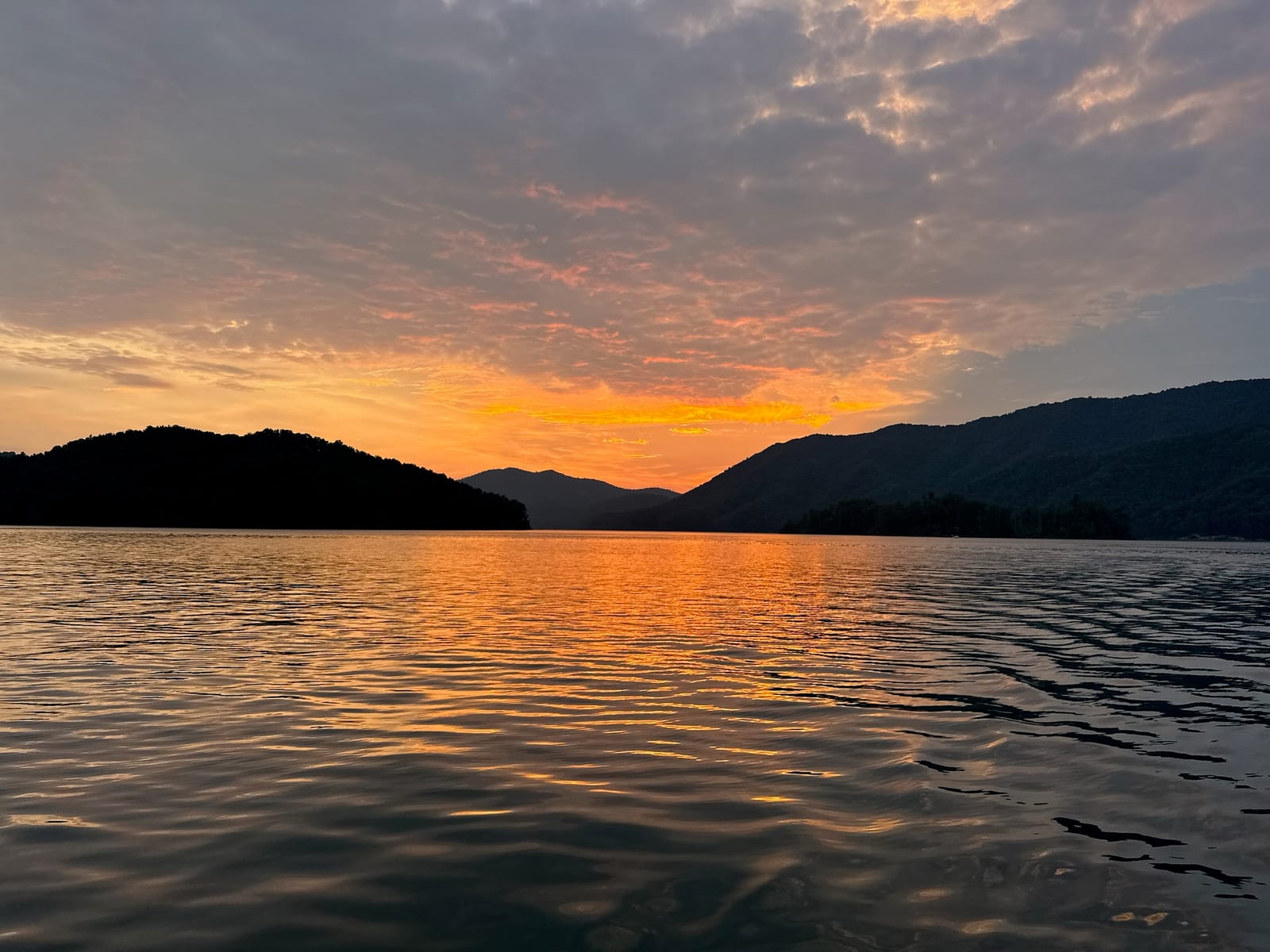
The defining feature of Watauga Lake is that the forest comes down to the water on three sides, almost entirely undeveloped (Cherokee National Forest), and the lake takes the color of whatever sky is above it. The light bouncing back off the water is the thing to capture.
For lake-scale shots, you need elevation. Shooting from water level gives you a small slice of the lake and a wall of trees. Shooting from the hillsides above gives you the full shape of it.
The deck of our townhouse is one such spot. The roadside pullouts on US-321 between Hampton and the dam offer several others. There is a particularly good pullout about three miles east of Hampton, on the right side as you head toward the dam, that opens up a south-facing view of the lake with Pond Mountain across it. Park, walk twenty feet, and you have the shot.
For the panoramic version, the dam observation point is the best public spot. Drive TN-67 east from Hampton toward the dam. There is a parking area at the top with a railing-fronted overlook. The view looks back up the length of the lake. Best in early morning, when the water is still and the light is coming in from your left. By late morning the light flattens.
If you are willing to hike, the summit of Pond Mountain (about 4 miles round trip, steep) gives you the only view of the full length of the lake from a single position. Karen has not been up. I have been up three times. The view is worth the climb. Bring a wide-angle lens.
Gear notes for lake-scale work: a 24-70mm zoom does almost everything. A wide-angle (16-35 or equivalent) helps when you want to include sky. A polarizing filter is the single most useful accessory, because it kills the surface glare on the lake and saturates the water color. Use it. Do not skip it. If you are shooting on a phone, the wide and ultra-wide lenses both work for this. Try both and pick the framing that includes the most reflection.
Sunrise on the lake
The lake faces several directions depending on where you are on it, but for sunrise purposes the main shoreline curves enough that any east-facing cove works. Watauga Point Recreation Area on the south shore is open early and gives you a flat, accessible vantage. There are picnic tables. Park, walk to the water, set up before official sunrise time.
The thing to watch for at sunrise on this lake is mist. On a still morning with cold air and warmer water — which is most mornings from late September through mid-November, and again in late spring — there is fog hanging over the surface in patches. The sun coming through that fog, with mountains behind it, is what every landscape photographer comes here for. It does not happen every morning. It happens often enough that if you are here for a week and you make the effort three mornings out of seven, you will get one.
Be at the lake thirty minutes before official sunrise. The good light is before the sun is up — the pink and orange in the sky, reflecting off the water, with the mountains as silhouettes. Once the sun is up over the ridgeline, the contrast gets harder to manage. By an hour after sunrise the magic is mostly gone for big-vista work, and you are better off looking for smaller details.
Gear: tripod. Always a tripod. Cable release or two-second timer. ISO low. Aperture around f/11 for depth of field. Bracket exposures if you are not confident in your light meter — the dynamic range between the sky and the foreground is real.
Phone notes: modern phones can do this if you find the lowest-ISO setting and brace against something solid. The phone’s automatic HDR helps with the dynamic range. The big limitation is you cannot manually control the exposure as precisely. Phone photos of sunrise on the lake can be very good. They will not be magazine-cover good unless you get extraordinarily lucky.
The AT dam crossing
The Appalachian Trail crosses the top of the Watauga Dam, which is one of the strangest and best photo subjects in the region. You are standing on a 331-foot-tall earthen wall, with the lake stretching away on one side and a thousand-foot drop into the river gorge on the other, and the trail is just a path along the top with a low railing.
This is a place for wide-angle work. The dam itself is the subject, with the lake as the context. The light is best in late afternoon — the dam runs roughly east-west, and a late-afternoon sun puts long shadows along its length and warms up the stone face.
If you want a person in the shot for scale, the AT crossing usually has a thru-hiker or section hiker walking it during spring and summer. Wait twenty minutes and somebody will come along. Ask permission to include them. Most are happy to be in a photograph, and it makes the scale of the dam legible.
The view from the dam looking up the lake (north-northwest) is a classic. The view from the dam looking down at the river gorge below (south) is more dramatic and less commonly shot.
Gear: wide-angle is your friend here. A 16-35mm or 14-24mm. If you have a graduated neutral density filter, this is the place to use it — the sky is much brighter than the shadowed gorge below.
Logistics: park at the dam observation lot and walk down to the trail. Then walk out onto the dam. There is no admission, no permit, no schedule. Just go.
Carvers Gap and the Roan Highlands at sunrise
This is the single best landscape photography location within a 90-minute drive of the lake. Carvers Gap sits at 5,512 feet, on the Tennessee-North Carolina line, with the Roan Highlands grass balds running north from it. The light at sunrise is unreal.
The drive from the lake takes about an hour via TN-143 through Roan Mountain State Park. You want to be in the Carvers Gap parking lot at least an hour before official sunrise. Bring a headlamp.
From the parking area, you hike up the AT to Round Bald, which is the first of the grass balds and the most accessible. It is about half a mile up with maybe 300 feet of elevation gain. Easy enough in the dark with a headlamp. From the top of Round Bald you have a 360-degree view of the southern Appalachians — Grandfather Mountain to the east, the Black Mountains to the south, the Smokies on a very clear day to the southwest.
The light at sunrise on Round Bald goes pink, then orange, then gold across the grass. The mountains around you stack in layers, each ridge a slightly different shade of blue. On a foggy morning the valleys below fill with cloud and you are on an island above the world.
Bring layers. The summit is windy and cold even in July. In April or October you may want a hat and gloves. In winter the snow gets serious.
Gear: I bring a 24-70 and a 70-200 to Carvers Gap. The wide for the panoramic. The telephoto for compressing the layers of distant ridges. Tripod essential. The 70-200 shot of layered ridges at sunrise — each ridge a different gradient of blue, like an Albers painting — is the Roan Highlands shot you’ve seen on the cover of every regional magazine for the last decade. Get it once and you understand why people drive up there before dawn.
Phone note: the phone will struggle with the dynamic range at sunrise here. Use the phone’s pro mode if it has one. Underexpose slightly. The phone’s HDR will lift the shadows.
A warning: do not leave anything visible in your car at the Carvers Gap lot overnight. There have been break-ins. If you are pre-dawn arrival, take everything out of sight or take it with you.
Linn Cove Viaduct on the Blue Ridge Parkway
About an hour from the lake, on the Blue Ridge Parkway near Grandfather Mountain. The viaduct is a curving concrete bridge wrapped around the side of the mountain, and it is one of the most photographed structures in the southeast.
The classic shot is from the Linn Cove Viaduct Overlook, which is about a quarter mile north of the bridge on the Parkway. From the overlook there is a paved trail that goes down and around to a view of the viaduct from below, with the mountain wall behind it.
Best light: early morning, especially with mist in the valley below the bridge. The viaduct runs roughly north-south, so morning sun lights up its east-facing curve. By afternoon the bridge is in shadow and the photo is less interesting.
Best season: October for foliage around the bridge. May for the rhododendron and fresh green leaves. Winter for clean lines without leaves, especially after a snow.
Gear: 70-200mm telephoto for the compressed view of the bridge against the mountain. A wide-angle does not really work here — you need the compression of the telephoto to make the bridge feel like it is sitting on the mountain.
If you want to shoot from the bridge itself, you cannot stop on the bridge (the Parkway prohibits stopping there). Park at the visitor center on the south end and walk back along the trail.
Eagles
There are active bald eagle nests on Watauga Lake. The local birding community knows where they are. The convention is to not publish exact coordinates, because eagles are easily stressed by humans approaching nests, and federal law protects them at a 660-foot buffer.
If you want to photograph eagles, you need real reach. A 400mm lens minimum. A 600mm if you have it. A teleconverter on a 70-200 will get you to 400mm, which is the floor. Hand-held is hard at that focal length — bring a tripod or monopod.
The strategy is to find a public viewpoint within sight of (but well away from) a nest, set up, and wait. The Watauga Point Recreation Area has been a known viewpoint. The Rat Branch Boat Launch is another. The eagles fish the lake all year, and during nesting season (February through July) the parents trade off shifts at the nest and make regular trips out over the water hunting.
Best season for eagle photography: late spring, when the eaglets are visible in the nest and the parents are most active. The light at the lake in May is good, the water is calm in the morning, and the eagles are highly active. Be patient. Three hours in a hide produces one good shot if you are lucky. Six hours produces two.
Ethical note: do not approach a nest. Do not play recordings to lure birds. Do not flush birds for a better angle. If a bird is acting agitated by your presence, you are too close, period. Back up. There are entire chapters of audubon ethics on this and they are worth reading.
Wildflowers
Spring wildflowers, particularly trillium and bloodroot, are good photo subjects from late March through May. The trick with wildflowers is light. Direct midday sun on a small white flower is harsh and washes out detail. Overcast days are ideal. Open shade is ideal. The first hour after sunrise and the last hour before sunset are the best direct-sun windows.
Use a macro lens or a regular lens with a close-focus capability. A 100mm macro is the standard tool. A 24-70 set to its closest focus also works for many compositions. Get low. Wildflower photos taken from standing eye-level are almost always worse than wildflower photos taken from the ground.
Tripod with a reversible center column or a low-angle setup helps. So does a reflector — a small white card to bounce a little light into the shadows of the flower.
Phone note: phones are surprisingly good at this. Most modern phones have a macro mode. Get the phone an inch from the flower, hold steady, and let the autofocus do its work. You will get publication-quality images for personal use.
Fall foliage
I have a whole separate set of opinions on the fall, which the fall foliage piece covers in detail. The short version: peak is October 10 to 25, the lake itself is the best foreground for color, and the AT dam crossing and the Roan Mountain loop are the two highest-value photo locations.
For fall work specifically, polarizing filter is even more important than usual. It cuts the haze that often hangs over the mountains in October and saturates the color.
Winter
Watauga Lake in winter is underrated as a photo subject. The lake stays mostly ice-free, the surrounding mountains often have snow on the upper elevations, and the contrast between dark water, snow-dusted forest, and pale sky is striking.
The best winter shots come the morning after a fresh snow, when the trees still have snow clinging to them and the sun comes up clean. Get up there early. The snow falls off the trees by mid-morning once the temperature climbs.
Carvers Gap in winter is dangerous and beautiful. The road up TN-143 is sometimes closed. Check conditions. Roan Mountain State Park’s office posts updates.
My usual gear
Since people ask. I shoot a Sony mirrorless body. My most-used lens at the lake is a 24-105 f/4. I have a 100-400 for wildlife and long-distance landscape compression. A 14-24 wide-angle for big skies and the dam shot. A tripod that I carry more often than I want to. Filters: polarizer always, a 6-stop ND for water work, a graduated ND for high-contrast skies.
I shoot RAW. I edit in Lightroom. I do not consider any of that load-bearing for the kinds of photographs that make a vacation memorable. A phone photograph of your kids on the dock at sunrise is more valuable than my best edited RAW from Carvers Gap. Take both kinds. Look at the light. Be there for the light. The gear matters less than being awake at six in the morning when the mist is on the water.
A few more rules
Walk slower than you want to. Sit longer than feels natural. Most of the photos I am proudest of came from staying in one spot for ninety minutes when I had planned to stay twenty. The lake is patient. The light changes. The birds come in. Something happens. The trick is to be there when it does.
If you are staying with us, the back porch is one of the best stationary photo positions on the lake. You can set up a tripod, leave it there for the morning, and shoot the whole sunrise sequence from a chair with coffee. That is most of my best lake images. Coffee, chair, tripod, patience.
And: ask permission before you photograph people you do not know. The thru-hikers on the AT, the fisherman on the dock, the volunteer at the museum. Most will say yes. Some will say no. Either answer is fine. The asking is the thing.
Want to stay at the lake?
Our modern two-bedroom townhouse has sweeping lake and mountain views, a jet tub, and a gas fire pit on the back porch.
Common questions
Can I get a good photo with just a phone?
When is the best light at the lake?
Where are the bald eagles?
Do I need permits for any of these spots?
More like this
Keep reading
Fall foliage at Watauga Lake — when, where, and what nobody tells you
When fall color peaks at Watauga Lake, which drives and trails are the best for it, and the timing t
Spring at Watauga Lake — a month-by-month walk-through
What spring is like at Watauga Lake from March through May — wildflowers, water temperature, the fis
Where to stay on Watauga Lake
A practical look at where to stay around Watauga Lake — the lakefront cabins, the hilltop townhouses
The Appalachian Trail at Watauga Lake
The AT crosses on top of Watauga Dam — a 15-minute drive from the door, with one of the most photographed views on the entire 2,200-mile trail.
Cherokee National Forest from Watauga Lake
Watauga Lake sits inside the Cherokee National Forest, which is most of why the shoreline is undeveloped and the water is so clear.