
Birding at Watauga Lake — eagles, ospreys, loons, and the spring warbler wave
A birder's guide to Watauga Lake — bald eagles, ospreys, winter loons, wood ducks, and the spring warbler migration through Cherokee National Forest.
By Karen · May 12, 2026
On this page
I keep a pair of Vortex 8x42s on the kitchen counter next to the coffee maker. That should tell you most of what you need to know about how I spend my mornings. Bill teases me about it, but he’s the one who pointed out the first eagle to me a few months after we moved up from Florida, so he doesn’t get to talk.
This is the article I wish someone had handed me when we got here. Not a checklist of every bird ever seen on the lake (eBird does that better), but a working guide to what you can reasonably expect to see, where to stand, and when to come.
Start with the eagle
The bald eagle is the bird that gets people to look up. We have them. Year-round. They breed in the Cherokee National Forest around the lake and they’re on the water most days I’ve bothered to look.
You see them two ways. The common way is from the deck of a rental or from the boat — an adult eagle flying a low, lazy line up the lake, sometimes a quarter-mile out, white head and tail catching the sun against the dark mountainside. The less common but more memorable way is from a kayak or a pontoon when you’ve drifted close to a dead snag and one is already there, watching you the way a cat watches a fish.
The best time of year is late November through February. The breeding pairs that live here year-round get joined by wintering birds that have come down from farther north, and on a good morning in January you can count three or four different individuals from a single vantage point. The lake stays mostly ice-free, the fish are still catchable for an eagle, and the leaves are off the trees so you actually see them.
Where to stand:
The Watauga Dam overlook on the south side of the lake is the single best place I know to see eagles. Park, walk to the railing, scan the dead snags along the far shore. You’ll often see them perched, sometimes two to a tree. I’ve been there at dawn in December and watched an adult fly across the dam at eye level.
The public boat launch area in our cove is a close second. A pair has used a snag above the launch for at least the three winters I’ve been watching. They show up at first light, often before the fishermen do.
Shook Branch Recreation Area in summer. The beach gets too busy in the middle of the day, but at 6:30 AM you have it to yourself, and eagles cruise the cove looking for the fish that gather there.
And — the deck of any hilltop rental, including ours. Elevation matters with eagles because you’re at their cruising altitude rather than under them. Coffee on the porch is real birding.
Osprey, who you’ll see more often
If the eagle is the headliner, the osprey is the bird you’ll actually see most often if you come between April and September. They’re summer residents here. They migrate south for the winter and come back in spring to nest, and they spend their days diving on the lake for fish in the exact way the eagles mostly don’t bother to.
The diving is the show. An osprey will hover ten or twelve seconds above the water, then fold its wings and drop straight down, hitting feet-first with a splash you can hear from a hundred yards away. They miss as often as they hit, which is humbling and also what makes you keep watching.
Best places to see this:
- The main lake basin near the dam, especially in the late afternoon when the surface goes glassy
- Any wide open stretch of water — they prefer to hunt where they can see down
- From a boat, anywhere
We had a pair last summer that fished the cove below our place every evening around 6. They got more comfortable with us over the season. By August one of them was diving fifty feet from a kayak my daughter was paddling.
The great blue heron, who is everywhere
Year-round, every day, often standing motionless in six inches of water at the edge of any cove. The great blue heron is the bird you’ll see whether you’re trying to or not. They’re not exciting to a birder who’s seen a hundred of them — but a kid who’s never watched one stab a fish will remember it for a long time.
They like the marshy edges of the lake, especially where small creeks come in. The mouth of Pond Creek on the north shore is a reliable spot. So is anywhere you can find a fallen log half-submerged near a cove — they roost on those.
The green heron is less common but also present, smaller and chunkier, working the same edges in summer.
Wood ducks, kingfishers, and the cove birds
A few birds live the small life on Watauga, working the wooded coves rather than the open water.
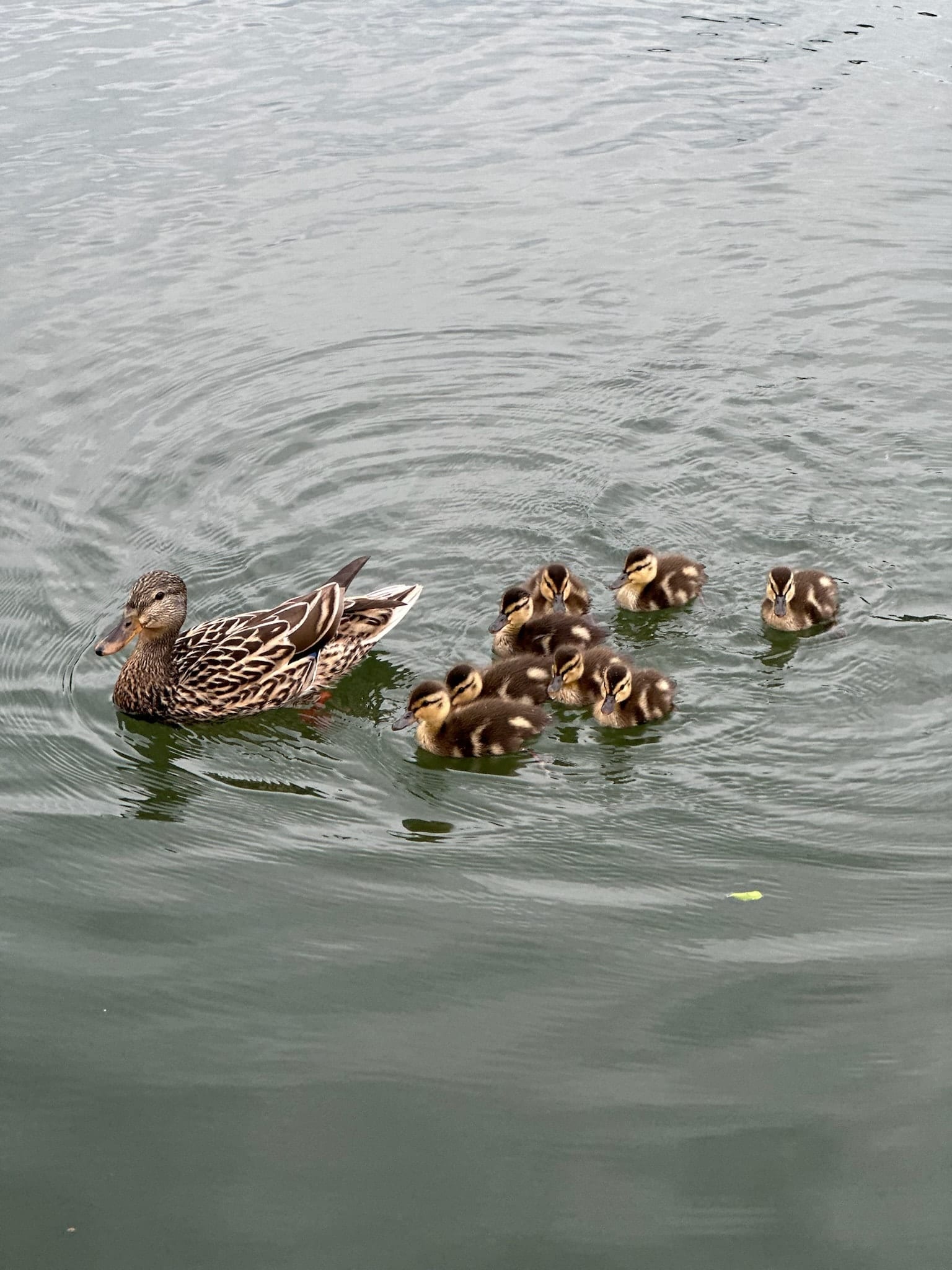
Wood ducks are my favorites of these. The drake is improbably beautiful — iridescent green and chestnut with a white face stripe, the kind of bird that doesn’t look like it should exist in the wild. They nest in tree cavities along the wooded edges of the lake and you see them in spring and summer, often in pairs or with a brood of ducklings paddling in a line. The quiet coves on the north side of the lake near Butler are the best place for them.
Belted kingfishers are constant. The loud rattling call is their tell — once you learn it, you’ll hear them every day. They perch on overhanging branches or power lines near the water, dive for small fish, and let you know exactly where they are. They’re skittish, though. A kayak that drifts too close will send them rattling fifty yards down the shore.
Cormorants show up in numbers in winter and early spring. Hooded mergansers are a winter possibility on the coves — the drake with that white-fan head is a great find. Common mergansers turn up too, especially in late winter near the dam.
Winter loons — the surprise of November
This one surprised me my first year. Common loons are not nesting birds in Tennessee. But they do migrate through TVA reservoirs in late fall and early spring, and a small number winter on lakes like Watauga where the water stays open and the fishing is good.
The first one I saw was the day after Thanksgiving from the dam overlook. A single bird, gray and white in winter plumage (not the dramatic black-and-white you’d see on a Maine pond in summer), diving and reappearing forty yards down the bank a minute later. They’re quiet here — no yodeling. But they’re real, and they’re a worthwhile reason to bird Watauga in November and December.
You won’t see them in summer. They’ve gone north to breed. Late October through early April is the window.
Spring warbler migration — the reason serious birders show up
If I had to pick one week of the year to bird the Watauga area, it would be the first or second week of May.
The Cherokee National Forest sits on a major migration corridor for songbirds moving north along the Appalachians, and Watauga Lake is right in the middle of it. From late April through mid-May, you can find a remarkable variety of warblers, vireos, tanagers, and thrushes moving through the woods around the lake and the higher elevations on Roan Mountain.
I’m not going to pretend I’m the birder who can name every warbler by song. I know the easy ones — yellow warbler, common yellowthroat, hooded warbler, black-throated green, and the ovenbird that wakes me up at 5 AM all summer. The eBird checklists from the Watauga Lake hotspots in early May regularly include 15 or more warbler species. If that’s your thing, come then.
Where to bird the warblers:
- The Watauga Lake Trail along the south shore. Walk it slowly at dawn. Listen more than look.
- Higher up on Roan Mountain (30 minutes from the lake). The elevation gradient means different species at different heights. The Rhododendron Gardens at the top hold breeding birds you don’t get at lake level.
- Any trail in Cherokee NF that follows a creek bottom. Warblers concentrate near water in migration.
Practical stuff
Optics. A reasonable 8x42 binocular is the right starter. Vortex Diamondback or Nikon Monarch are both under $300 and good enough. If you bird waterbirds and you have a scope, bring it for the loon and eagle work from the dam overlook.
Field guide. Sibley’s Eastern, on paper or in the app. The Merlin app from Cornell is genuinely useful for ID by photo or sound — I use it for warblers when I can’t see them in the leaves.
Time of day. Dawn for almost everything. The hour from sunrise to about 8 AM is when the most birds are most active. Late afternoon is second-best, especially for raptors and waterbirds.
Where to stay. Anywhere with elevation and a view helps. The hilltop rentals (ours included) give you porch birding. The lakefront cabins put you closer to the water-level birds but limit your sky.
Reporting. Submit your eBird checklists. The Watauga Lake hotspots — there are several covering the dam, the public boat launch, Shook Branch, and the Pond Creek area — benefit from every visit logged.
What to skip if you’re new
Don’t try to bird the whole lake in one day. It’s 6,430 acres and most of the shoreline is inaccessible by car. Pick a hotspot, work it for two hours, move to a second one.
Don’t bird the middle of a summer afternoon. You’ll see nothing. Heat, sun, and recreational boat traffic all push birds out of view.
Don’t expect a shorebird show. Watauga is a deep mountain reservoir, not a mudflat. You’ll get a yellowlegs or a spotted sandpiper occasionally, but it’s not a shorebird destination.
A morning worth getting up for
If you have one good morning, here’s how I’d spend it.
Up at 5:30. Coffee on the porch. Scan the cove and the visible ridges for the first ten minutes — you’ll often hear an ovenbird or a wood thrush before you see anything. Drive to the dam overlook by 6:15. Scope the snags for eagles, the water for loons in winter or osprey in summer. By 7:30, drive five minutes to the Watauga Lake Trail and walk slowly for an hour, listening. Back at the rental by 9, second coffee, log your checklist.
That’s a good morning. The lake gives you that on most days if you show up early enough.
If you want help — Bill knows the boat-launch eagle spots better than I do, and either of us can tell you what’s been around in the week before your stay. Ask when you book.
Want to stay at the lake?
Our modern two-bedroom townhouse has sweeping lake and mountain views, a jet tub, and a gas fire pit on the back porch.
Common questions
Are there really bald eagles at Watauga Lake?
When is the best birding of the year here?
Do I need a scope?
Where do I report sightings?
More like this
Keep reading
A real fishing guide to Watauga Lake
A working guide to fishing Watauga Lake — species, seasons, where to launch, what to throw, and whic
A family vacation at Watauga Lake
How to plan a family trip to Watauga Lake — what works for kids, what doesn't, swimming and boating
Where to stay on Watauga Lake
A practical look at where to stay around Watauga Lake — the lakefront cabins, the hilltop townhouses
Cherokee National Forest from Watauga Lake
Watauga Lake sits inside the Cherokee National Forest, which is most of why the shoreline is undeveloped and the water is so clear.
Fishing on Watauga Lake
A 6,430-acre reservoir with bass, walleye, trout, and crappie, and the kind of clean cold water that holds them through summer.